
What is Enterprise Architecture?
The definition for the term Enterprise Architecture (EA)
ISO/IEC 42010: 2007 i defines ‘‘architecture’’ as: ‘‘the fundamental organization of a system, embodied in its components, their relationships to each other and the environment, and the principles governing its design and evolution.’’
TOGAF® ii embraces but does not strictly adhere to ISO/IEC 42010: 2007 terminology. The term Architecture has two meanings depending upon the context:
- A formal description of a system or a detailed plan of the system at component level to guide its implementation.
- The structure of components, their inter-relationships and the principles and guidelines governing their design and evolution over time.
Currently the Architecture Forum within The Open Group, responsible for TOGAF® is working on a formal response related to the definition of EA.
Wikipedia iii uses a number of sources to sum EA up in the following way:
“To some, 'enterprise architecture' refers either to the structure of a business, or the documents and diagrams that describe that structure. To others, 'enterprise architecture' refers to the business methods that seek to understand and document that structure. A third use of 'enterprise architecture' is a reference to a business team that uses EA methods to produce architectural descriptions of the structure of an enterprise.“
How Real IRM Defines and uses EA
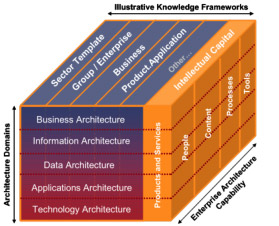
Enterprise Architecture is the cornerstone of Real IRM’s market focus. EA is the vehicle we use for integrating the resources necessary to create a complete view of the organisation, as well as to provide products and services to facilitate the organisation’s transition to an integrated environment with optimised processes that are responsive to change and to the delivery of the business strategy.
Defining the EA role within an organisation
An enterprise architecture role within an organisation is cross-disciplinary, requiring integration of diverse skills, methods and tools, within and beyond the technology community. Holistic EA is pragmatically developed through the ongoing collaboration between business role players, the IT executive team, and the EA team.
In order to understand EA and our solution offering, it is important to comprehend how the knowledge frameworks, the EA Capability, and the Business, Information, Data, Application and Technology (BIDAT) architectures are systemically inter-related.
http://www.iso.org/iso/catalogue_detail.htm?csnumber=45991
The Open Group South Africa TOGAF
http://en.wikipedia.org/wiki/Enterprise_architecture
We advise the reader to refer to the diagram while reading the following subsections.Knowledge Frameworks
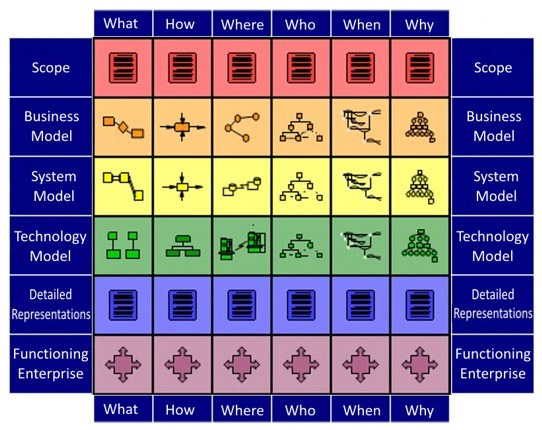
The role of an EA Framework is to provide a logical structure for classifying and organising the descriptive representations (i.e., models) of an enterprise. The framework used to structure the contents of the EA Repository is that of John Zachman, the internationally acknowledged authority on EA.
The Zachman Framework allows for the description of complex objects by addressing the objects from different perspectives within a framework. It structures models of the Enterprise or Information Management (IM) products, services or solutions from the perspective of various people (or roles) involved with conceptualising, managing or owning, designing, building and operating the system or business. In essence, the framework answers the fundamental questions of What, How, Where, Who, When and Why from differing role perspectives such as those of the functional director, project sponsor, business process owners, process specialists, developers and end-users.
Although the Zachman Framework applies to enterprises, the Framework itself is generic. It is a comprehensive, logical structure for the descriptive representations (i.e. models, or design artefacts) of any complex object, and does not prescribe any particular method, representation technique, or automated tool.
The framework’s strength is that it provides a method of thinking about an enterprise in an organised way, so that it can be described and analysed. It also enables the individuals involved in producing enterprise information systems to focus on selected aspects of the system, without losing sight of the overall enterprise context. In designing and building complex systems, such as enterprise systems, there are simply too many details and relationships to consider simultaneously.
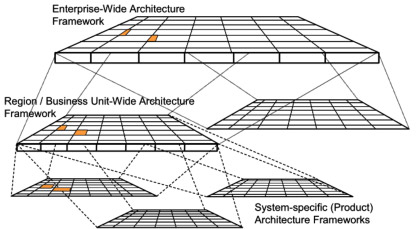
At the same time, isolating single variables and making design decisions out of context would result in sub-optimisation, with all the attendant costs and risks. The challenge is the same whether the system is physical, like a smelter, or conceptual, like an enterprise system. How should the system be designed and built, piece-by-piece, and step by step, so that it achieves its purpose without losing its value or raising its cost by optimising the pieces while sub-optimising the overall?
Experience has shown that organisations rapidly reach a critical mass of model content. At this stage a virtuous feedback-loop develops, as individuals perceive that they obtain more value than the cost of their personal contribution to the organisation’s knowledge base of models. Business models are, for example, re-used for package selection, development and implementation; the same models are also used by the Audit and Risk Management function or Six Sigma business process improvement initiatives. The re-use of an existing model results in a 90-95% return on the development cost of the model.
This systemic approach converts tacit knowledge about the enterprise, its strategies, products, processes and customers into explicit information that is actionable.
Architecture Domains

Although the Zachman Framework has become the de facto standard in Enterprise Architecture, the framework is perhaps too complicated for general business use. We have a simplified framework for business communication while the EA team rigorously applies the Zachman Framework to manage models within the EA repository. This simpler communication-framework addresses the Business, Information, Data, Applications and Technology architecture domains - referred to as the “BIDAT framework”. We have developed a direct mapping between the BIDAT model and the Zachman Framework and have generated tools that can, for example, generate websites based on a specific architectural layer.
This approach enables the deployment of models that hide complexity and provide simple, easy access to deliverables such as the business model, job descriptions, role accountability matrices, performance measures, application functional specifications, middleware specifications etc. Our technical capability ensures that “the model is the documentation”. This means, for example, that the functional specifications (e.g. e-Business software) and training materials are generated directly from the model in the form of Microsoft Word documents and/or a website. This reduces the fragmentation of documentation, provides a repository that houses key components of the organisation’s intellectual capital in a format that is actionable, and directly supports organisational agility. We have practically applied the concept of holistic EA for a number of years. This has now become a best practice recommended by Gartner Group.
"Through 2010, less than 20% of the Global 2000 would master business transformation using IT, allowing them to outpace the rest in strategic goals such as revenue and market share."
The following are the architecture domain definitions:
- Business Architecture - The business policies, strategies, people, processes, business rules, products, services, customers, geographical span, partners and competitors define the enterprise. The business architecture is thus the context within which the business operates.
- Information Architecture - All the sources of information, supporting business and decision processes, including paper, graphics, video, speech and thought that defines the sources and destinations of information, its flow through the organisation, as well as the rules for persistence, security and ownership.
- Data Architecture - As a subset of the information that drives the enterprise, the data architecture defines the types of data, their form, and the rules that govern their use. The elements of this layer are the only forms of information that must be stored by information technology.
- Application Architecture - The applications that the enterprise chooses to access and manipulate its data also help to define its ability to communicate internally and, through electronics commerce, externally.
- Technology Architecture - Underpinning the other layers, the technology of the enterprise enables or disables the enterprise in its execution of its business strategy. The implication for the technology architecture is that the choice of servers, client devices, databases, middleware and network components must be linked ultimately to the policies and goals of the business architecture.
The EA capability provides multiple views of the BIDAT framework such as:
Time-Based View
Time-based views are defined for the architecture domains. An enterprise can be represented by several different architecture instances, each representing the enterprise at a particular point in time. One architecture instance will represent the current enterprise state (the "as-is", or baseline). Another architecture instance, perhaps defined only partially, will represent the ultimate target end-state (the "vision"). In-between, intermediate or "transitional" architecture instances may be defined, each comprising its own set of target architecture descriptions. These time-based views support strategic and tactical planning, budgeting and enterprise portfolio management.
Role-Based View
The EA capability provides role-based views of the architectural domains, tailored to the specialised needs of, for example, software deployment, application integration, organisational design, training and development, risk, audit, business process improvement etc. This capability supports knowledge management as personal, tacit knowledge is capture in models and directly linked to the business process at an activity level. The linking of information to the business process and business role is superior to conventional knowledge management approaches that simply focus on content management because this “human centred” approach links those who “know” to those who need to know and supports their collaboration and knowledge transfer. Existing documentation, such as presentations, training material, technical diagrams etc., is linked to the business processes and is often stored in a documentation management system such as Documentum or SharePoint and is subjected to configuration management and change control. The intranet provides easy and relatively inexpensive access to the model content.
Globalisation and Portfolio Management
The design of the architecture domains provides Global, Regional and Local views of the EA. A current best operating practice template provides a benchmarking capability and the means of transferring best practice systems across the group.
Variants of the architecture domains, such as Europe, America, South Africa etc., could be used to drive pragmatic globalisation (globally consistent processes) based on regional business needs, process maturity and the need to harness local innovation for the group’s advantage.
Strategic Planning View
The EA capability provides a unique opportunity for moving existing content into an EA repository with the business objective of transforming a static approach to developing business strategies into a “living” and dynamic business capability.
Other Viewpoints
The EA capability provides a number of views that support requirements for an IT Enterprise Architecture blueprint and the e-Business programme. These views include a:
- Risk View
- Data Stewardship View
- Information Security View
The following section provides an overview of how this is made practical and results in a business capability that is of strategic importance.
Enterprise Architecture Capability
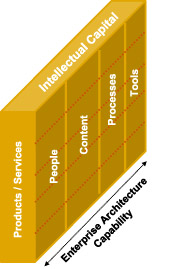
The purpose of the EA capability is to integrate the resources necessary to create a complete EA view of an enterprise, as well as to provide products and services to facilitate the organisation’s transition to an integrated environment with optimised processes that are responsive to change and to the delivery of the business strategy. This EA role is cross-disciplinary, requiring integration of diverse skills, methods and tools, within and beyond the technology community and comprises of:
People – The roles and skills of the individuals are aligned with the BIDAT architecture domains (Business Process Engineers, Information and Data Architects, Application Architects and Technology Architects), EA Office Support who primarily manages the EA office, and the technical team who develop and support the modelling office tools and technical products.
Tools – The toolset includes modelling tools that support numerous BIDAT modelling methods, utilities for managing model quality and integration, reverse engineering tools that synchronise database structures, reverse engineering of application code, reports and website generation tools for providing broad-based access to the model content, business process improvement tools such as simulation, and change impact assessments.
Content - The contents of the EA repository include principles, standards, inventory (such as the applications portfolio), models and roadmaps for the EA domains.
Process - The EA process, combines people, tools, and content in the delivery of EA products and services that add value to the customers of the BIDAT architectural domains.
Modelling Tools
We apply a vendor-independent approach that removes product bias and enables us to compare and integrate modelling products objectively without any preconceived agenda or vested interest. In order to preserve this independence, we do not accept product sale commissions. We keep abreast of developments of all the leading EA toolsets and use them to model the BIDAT domains. We have extended the functionality of some of the leading EA toolsets with a number of reports, utilities and web publishing tools and we are able to integrate these toolsets with modelling and other products such as MindManager, Microsoft Word, Visio, InfoPath and Excel. This capability reduces the cost of ownership and provides tools that the business community are familiar with and find less intimidating.
Process
We are the South African representative of The Open Group. The Open Group is a vendor and technology-neutral consortium, which ensures that multi-vendor information technology, matches the demands and needs of customers. It develops and deploys frameworks, policies, best practices, standards, and conformance programs to pursue its vision of “Boundaryless Information Flow” - the concept of making all technology as open and accessible as using a telephone.
We have developed a comprehensive toolset and methodology that supports the practical implementation of TOGAF® TM1. Our active involvement in extending TOGAF® provides our clients access to industry-leading EA capabilities.
Change leadership
Our EA and IT Governance methodologies incorporate organisational change management. This approach includes the eight step change leadership approach devised by John Kotter and is used to structure the solutions into three broad phases. In essence, these phases prepare the organisation for the change, implement change and then anchor the change before iterating back to create more change. This means that the interventions are applied at the point in time at which they are most effective, while ensuring that the IT Governance and EA processes are sustainable.
Programme and Project Management
We apply the PRINCE2 project management method which has become the UK's de facto standard for project management. The method describes how a project is divided into manageable stages enabling efficient control of resources and regular progress monitoring throughout the project. The various roles and responsibilities for managing a project are fully described and are adaptable to suit the size and complexity of the project, and the skills of the organisation. Project planning using PRINCE2 is product-based which means the project plans are focused on delivering results and are not simply about planning when the various activities on the project will be completed.
Governance
Governance is fundamental for entrenching EA (essentially a new way of working) into a business. IT Governance, like other governance domains, is the responsibility of executives and shareholders (represented by the board of directors). It consists of the leadership and organisational structures and processes that ensure that the organisation’s strategies and objectives are sustained and extended by its ICT. Without adequate governance, enterprise architecture will remain a theoretical concept that will fail to deliver the desired business benefits. We apply CobiT and ITIL to embed the EA control-points within the broader business processes.
Content
The contents of the EA repository include principles, standards, inventory (such as the applications portfolio), models and roadmaps for the EA domains.
Models are developed incrementally based on business needs. The modelling development work is usually coupled with a strategic project or a business imperative. The use of the Zachman and BIDAT frameworks ensures that the incrementally developed models integrate into the whole. We have pre-packaged examples of EA principles, standards, inventory, models and roadmaps for the EA domains. Our technical capability can then be used to accelerate the population of content into the EA repository in order to provide models ahead of business need.
Enterprise Architecture - How it justifies its cost
- Enterprise Architecture is an asset - one invests in an asset to enable one to do something that one would otherwise be unable to do
- Alignment - Enterprise Architecture promotes alignment. Systems must align/match with management's intentions for the enterprise (TQM).
- Integration - Enterprise Architecture integrates information. As soon as the same information is available to everyone in the enterprise at the same time, the power will shift to everyone in the enterprise, including the customer so that the Enterprise becomes market-driven. Data must mean the same thing to everyone in the enterprise if empowerment is to be successful and is to function in a knowledge-based society. Also, business rules must be consistent across the enterprise (like standard interchangeable parts)
- Change - Enterprise Architecture creates agility for change. Descriptive representations of any object constitute the base-line for managing change to that object over time while minimising time, disruption and cost.
- Reduced Time-to-Market - Enterprise Architecture reduces time-to-market. Decrease the time it takes to produce an implementation from the time you receive the order. The components have to be engineered such that they (the appropriate components) can be assembled into more than one implementation anywhere in the enterprise. Architecture provides for an "assemble to order" strategy (mass customisation).
Enterprise Architectures Meets The Challenges
The Real IRM Solutions' proven approach to Enterprise Architecture provides a sustainable competitive advantage and is designed to assist organisations meet the following challenges:
- How to balance the delivery of immediate business-value while developing a longer-term strategic capability. This strategic capability holds the promise of making the organisation more responsive to change through the detailed understanding of business processes, the alignment of Business and IM, and the coupling of Knowledge Management with Enterprise transformation programs.
- How to achieve strategic competitive advantage, by moving from narrowly-defined technical architectures to holistic Enterprise Architectures that encompass the business, information, data, application and domain architectures.
- How to support concurrent modelling initiatives and prevent the Enterprise Architecture process from becoming a bottleneck in the delivery of projects.
- How to implement modelling and documentation standards across multiple projects, while simultaneously reducing costs and ensuring the re-use of models.
- How to maintain models once they have been developed, and to ensure that broad-based access to these models (and the information contained within them) is facilitated. The models need to become the documentation.
- How to accelerate the capture of existing and new models in order to reach a "critical mass" of content that supports cross-functional business contributions such as Knowledge Management, Risk Management and Organisational Design.
- How to "demystify" the architecture development process, so as to enable IT users to build genuinely open systems-based solutions and accelerate package implementations according to their business needs.
- How to move from a static business and IT strategy to a dynamic, "living" strategy that is continually maintained by the Enterprise Architecture process.
- How to transfer knowledge from software implementation partners to company staff in a modular format that is easily transportable, reduces risk and effectively shrink-wraps the application implementation for global reuse.
- How to apply the Enterprise Architecture capability in order to accelerate business integration and knowledge transfer thereby increasing the business-value derived from Mergers and Acquisitions (M&A).